In Conversation with Helen Lee
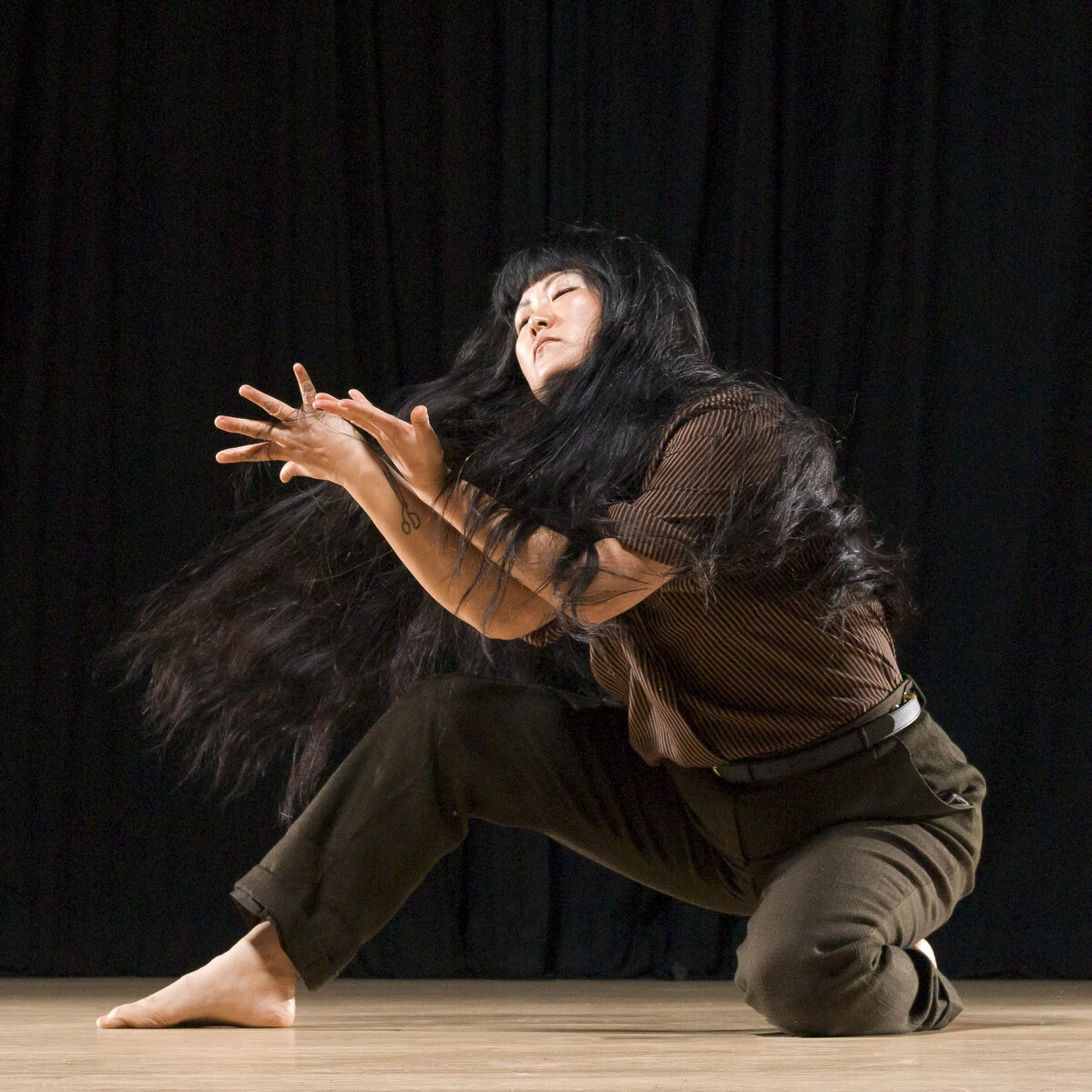
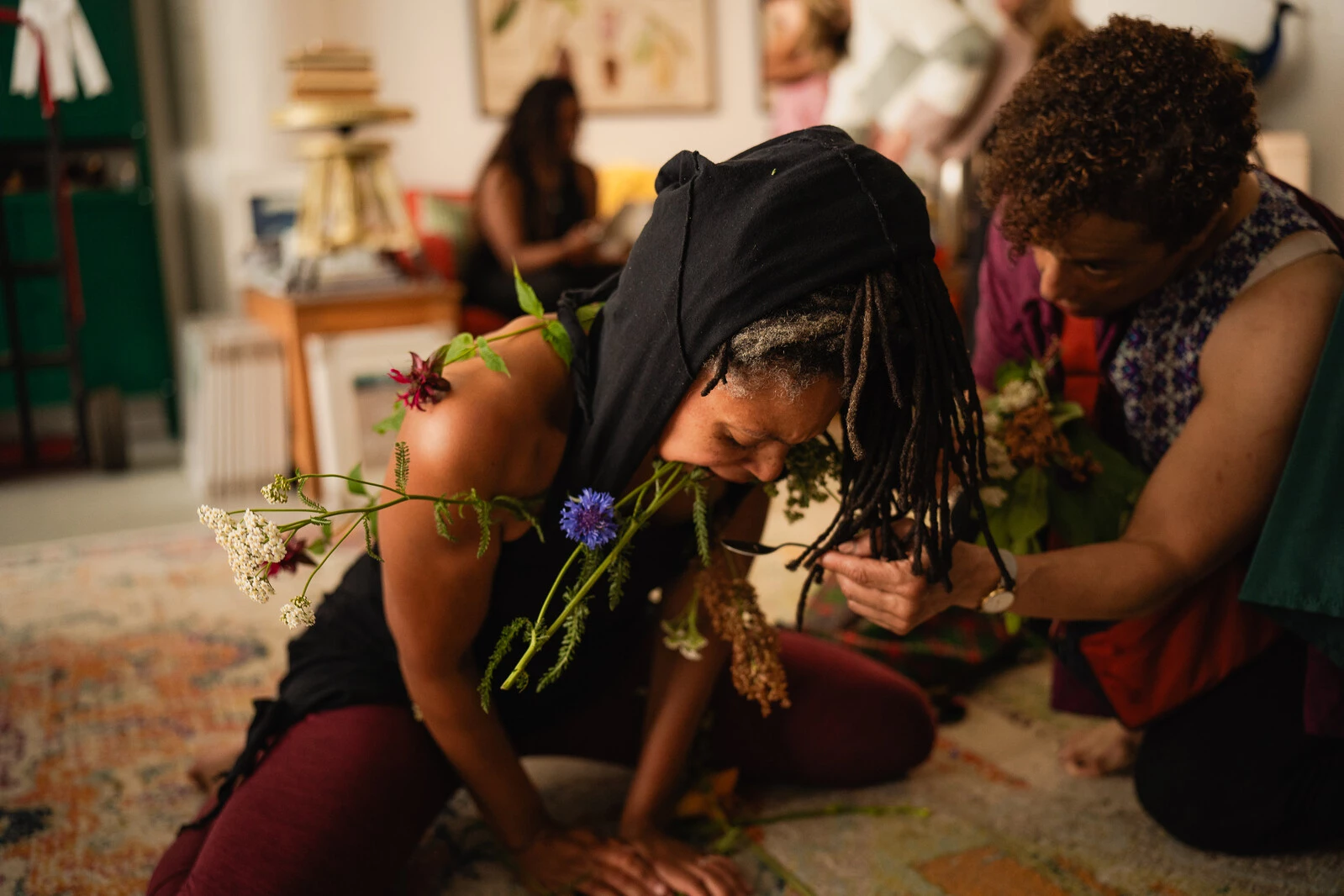

For the 2025 edition of Chicago Performs, Assistant Curator Laura Paige Kyber invited each of the featured artists to respond to a set of five questions, illuminating their inspirations, collaborations, process, and how Chicago shapes their work.
Below, interdisciplinary choreographer Helen Lee of Momentum Sensorium responds to Kyber’s questions, discussing her iterative project Curiosities of Wellness in Bodies of Grief and Joy, which invites audiences to sit with their own grief and cocreate a portal to joy by connecting to the physical body. The work continues at Chicago Performs this month.
This interview has been edited for length and clarity.
Laura Paige Kyber: Tell us about the origins of the project you’re presenting as a part of Chicago Performs. What were the seeds of inspiration?
Helen Lee: Back in February 2020, I found myself away from home longer than expected. A six week trip to Korea and Japan ended up being nine months away. While many deaths were happening around the world due to COVID-19 and hate against Blacks and Asians, I lost my aunt, cousin, Butoh mentor, and uncle in less than a year . . . and then more deaths continued to follow. Some of the deaths were by aggressive cancer, heart attack, heartbreak, and suicide.
The death of George Floyd reminded me of the LA Riots, the brutal beating of Rodney King, and the killing of Latasha Harlins by a Korean grocery store owner. So much hate was pulsating around the world. I imagined all of us inside an enormous cocoon, a mammoth cocoon. I wondered about our collective transformation and collective healing. For the next three years, I was working with the themes of butterflies, cocoons, and wars including the wars within ourselves. I was looking at Black and Asian allyship and the relationship between Malcolm X and Yuri Kochiyama.
Sitting in my own personal grief and the grievances of the world, I came across this quote from Desmond Tutu from The Book of Joy, written with the Dalai Lami:
“Discovering more joy does not, I’m sorry to say, save us from the inevitability of hardship and heartbreak. In fact, we may cry more easily but we will laugh more easily too. Perhaps we are just more alive. Yet as we discover more joy, we can face suffering in a new way that ennobles or elevates rather than embitters us. We have hardship without being hard. We have heartbreak without being broken.”
I am continually inspired by the seasons and how they affect us, recognizing everything, including grief and joy, is cyclical and impermanent. Previously, I was looking at grief and joy as separate or at least side by side. I was slowly realizing the entanglement of grief and joy was similar to the entanglement of light and dark, summer and winter. Grieving tends to be private, inside houses, and I wondered if there are ways we can grieve together in public spaces. I became curious about ways to merge/intertwine audiences and performers together to create an experience and opportunity to learn, stumble, and heal together.
LPK: What lineages of performance do you situate yourself within? Are there specific artists or traditions that you identify with?
HL: My interest and training in performance, dance, and art are spread across many traditions and artists. As a child, I studied some Korean traditional dances and was given piano lessons, but mostly I danced around to Madonna and Michael Jackson. Out of high school, I studied Polynesian dances (mostly Hawaiian Kahiko and Auana) for three years before going to school at University of Hawaii at Manoa from 1999 to 2003. In Hawaii, I was introduced to the works of filmmaker Maya Deren, choreographer Pina Bausch, theater, modern dance, and Butoh. I studied Butoh with Lori Othani who followed the lineage of Tatsumi Hijikata’s Ankoku Butoh. Later, I also studied with teachers, Eiko Otake, Tadashi Endo, and Maureen Freehill, who studied with Kazuo Ohno, the co-founder of Butoh. At UHM, my ballet teacher, Eve Walstrum, danced with Netherlands Dans Theater directed by Jiri Kylian. My modern dance teacher, Betsy Fisher, studied the German expressionist dances, and she learned, was directed in, and performed dances by Mary Wigman, Dore Hoyer, Marianne Vogelsang, Rosalia Chladek, Hanna Berger, Hanya Holm, Lotte Goslar, Alwin Nikolais, Murray Louis, and Beverly Blossom.
In 2000, I came across a magazine that spoke in depth about the work of Marina Abramović and was mesmerized. After 14 years out of school, I went to grad school at School of the Art Institute of Chicago and was introduced to artist-built environments by Lisa Stone, building furniture, pottery, growing and foraging foods by Sara Black, taxidermy artists by Giovanni Aloi, artist protests by Jennifer Dorothy Lee, and avant garde films by Tatsu Aoki.
I have been practicing yoga, meditation, and mindfulness since 1999. My meditation and mindfulness teacher Chozen wrote a beautiful book called How to Train a Wild Elephant and other Adventures in Mindfulness, and while reading it in 2015, I realized she had a monastery in Oregon. For six years, I traveled yearly to study with her in silent meditations called sesshin.
Meals are eaten as a meditation ritual of ōryōki with mindful eating practices.
My work combines many mediums, formats, practices, and modalities discovering new ways of performing and sharing by experimenting, playing, and sometimes failing along the way with process, execution, presentation, and location.
LPK: Who are your artistic collaborators on this project and how do you choose who to work with?
HL: There are more than 25 artists who are part of this iteration. Tuli Bera and Hannah Marcus have been working with me since 2023 on this project and they are assisting me to direct 20 performers to be Performance Guides.
The 20 Performance Guides are: Airos Medill, Ali Claiborne-Naranjo, Anniela Huidobro Castro, BelleAime Robinson, Christina Chammas, Cristal Sabbagh, Ed Clemons, Hannah Dubner, Harlan Rosen, Kezia Waters, LaMar Brown, Surinder Martignetti, Maddy Loehr, Madison Mae Parker, Najee-Zaid, Sara Zalek, Silvita Diaz Brown, SK Kerastas, Sophie Minouche Allen, Surinder Martignetti, and Xiaolu Wang.
They are a group of dancers, performance artists, poets, yogis, musicians, curators, visual artists, filmmakers, sound healers, body healers, and actors. I wasn’t necessarily looking for technically trained dancers but rather those who are intuitive, attentive, interested in care and caretaking, and can be good listeners. Many of the performers have never met each other and I know them from many different areas of my life. I love merging worlds together.
I recently collaborated with Haruhi Kobayashi where she sang some of my writings and poems and invited her to sing them for this project. Scott Rubin and I were paired up at a Freedom From and From To event at Elastic Arts and I knew I wanted to work with him again after playing his viola with my hair. Scott has been part of this project since 2023. Nick Turner attended an iteration of this project at High Concept Labs and later we also got randomly paired for Freedom From and From To at Elastic Arts in 2024. From there, I invited him to be part of this project playing eclectic guitar. Nick is also a social worker and wanted to incorporate this other facet of his identity for the grief community workshop.
We have many facets to ourselves—like gems—and I love incorporating the same artist who can play many roles. For example, BelleAime Robinson is a longtime collaborator: she plays crystal bowls supporting a Yin Yoga practice that I guide students through. BelleAime is also a yoga teacher, and I knew she would be a lovely fit to play her crystal bowl and be a Performance Guide as part of this project.
Likewise, I saw a beautiful movie called Falcon Lake (2023). Wilhelm Brandl is one of the composers of the film’s music. The sounds of this film continued to linger with me, and I reached out to ask if he would be interested in collaborating. Liz Bendure and Daniel Parker of TXATXA were asked by Chicago Dancemakers Forum to create a dish inspired by my work. I was so moved by what they created and have always wanted to work with chefs, having previously created a work about my dad in a dinner format. Currently, I am in plant medicine school with Alex William at First Curve Apothecary. I have been studying plant medicine online since 2019 and finally decided I wanted more hands-on training. My classmates have a wealth of knowledge and I’m grateful two of them, Dayna Larson and Isabella Romero, are contributing to this project with dried flowers and medical herbs. And finally, Amanda Marist is a longtime friend and collaborator and has been part of this project since 2023 as a performer. But for this iteration, she will be contributing some beauties from her garden space at BimBom studios.
LPK: How has making your work in Chicago impacted your artistic practice?
HL: Having the opportunity to make and share work in Chicago feels personal. I was born and raised here in Chicago. My parents immigrated to Chicago from South Korea in the mid-1970s, and I don’t think they expected one of their children to become an artist. What I do deeply confounds them. While I was studying dance and theatre in Hawaii, they often asked me when I would get a real job and give up my hobby. Haha!
When I was 12 our family moved to Florida to escape the Chicago winters, but after only a year we moved back. My family considered moving out to the suburbs where many Koreans moved to but time after time, my family stayed in Chicago.
Spending nearly five years in Hawaii was the first time I spent more than a year away from Chicago and it was an important time for me. It was where I began to honor where my family came from and begin to accept many parts of who I was and what I looked like. There were so many Asian Americans around me and this was something I was not used to growing up in Chicago.
I’ve been slowly and steadily making work in Chicago since 2004. And while I’ve had many opportunities to create work outside of Chicago, making work here in Chicago always feels special. I love being part of such a wide artistic community. As time passes and I enter my 40s, I begin to stand more and more in myself. This strength carries over in how I navigate the terrains of life and my artistic practice. In the past, I took myself way too seriously and now I feel I can laugh at myself more easily.
LPK: What would you like audiences to take away from experiencing this work?
HL: We must eventually say goodbye to everyone we meet in life, whether we want to or not. We will all experience loss. No one is exempt. I hope audiences will want to build a nourishing and grounding relationship with death and loss—ways of connecting joy and grief. Most of the world seems perpetually grief-phobic—grief illiterate. Most of us have an unhealthy relationship with death. In much of the US, cemeteries are tucked away or pushed to the outskirts. Our current funeral industry in the US, pushing aside more natural death rituals, was inspired by the use of formaldehyde to preserve the bodies of soldiers killed in battle so they could be sent back home. But it wasn’t always this way. Our ancestors held rituals—preparing the bodies of deceased family members at home, wearing black for months, tending to grief in community.
Other cultures retain these practices and hold healthier relationships to death. In Japan, I noticed small cemeteries scattered throughout neighborhoods, next to homes and active spaces—daily reminders to honor and respect the cycles of life and death. These rituals help people stay in touch with their grief.
I want audiences to learn to honor themselves, all parts of themselves, especially in the moments that can feel challenging and difficult. I want audiences to lean into their vulnerability and learn ways to find more ease, even if it’s just one percent or just a millimeter. Perhaps some will discover how to make friends with their anger or practice crying with dignity—and with time feel less shame.
Last year at Ragdale, with a group of small performers, at the beach we performed a water ritual to release anything we were holding onto back into the lake. Kate Laughlin, one of the performers, while in a different project, reached out to me to ask if it was okay to share this ritual I learned from Marika Heinrichs. I was delighted. I believe in a ripple effect and hope that anything the audience gleans from this experience will be shared with a friend, a loved one, perhaps, a stranger.
Each day, each one of us is creating. We create words, movement, thoughts, energy. We create relationships and conversations. How do we want to create? What kind of energy would you like to send from you out into the world? If you were a musical instrument, what kind of music would you like to play?
Shifts happen gradually. After each winter solstice, we gain one more minute of light each day until spring arrives—but not before moving through the Mud Season, a time of liminality. We live in a culture that doesn’t lean into small shifts. But one minute of light each day . . . accumulates. Thus, the shifts I am creating through my artmaking practices over the last few years have been gradual. They have to be. I imagine a version of this project being available for years to come—so that, through the dance and the art, people can feel more at home in their grief.