Night for Yoko Ono
February 18, 20267:30 pm - 9:30 pm
Please visit the MCA Box Office starting one hour before this program for standby tickets.
About the Performance
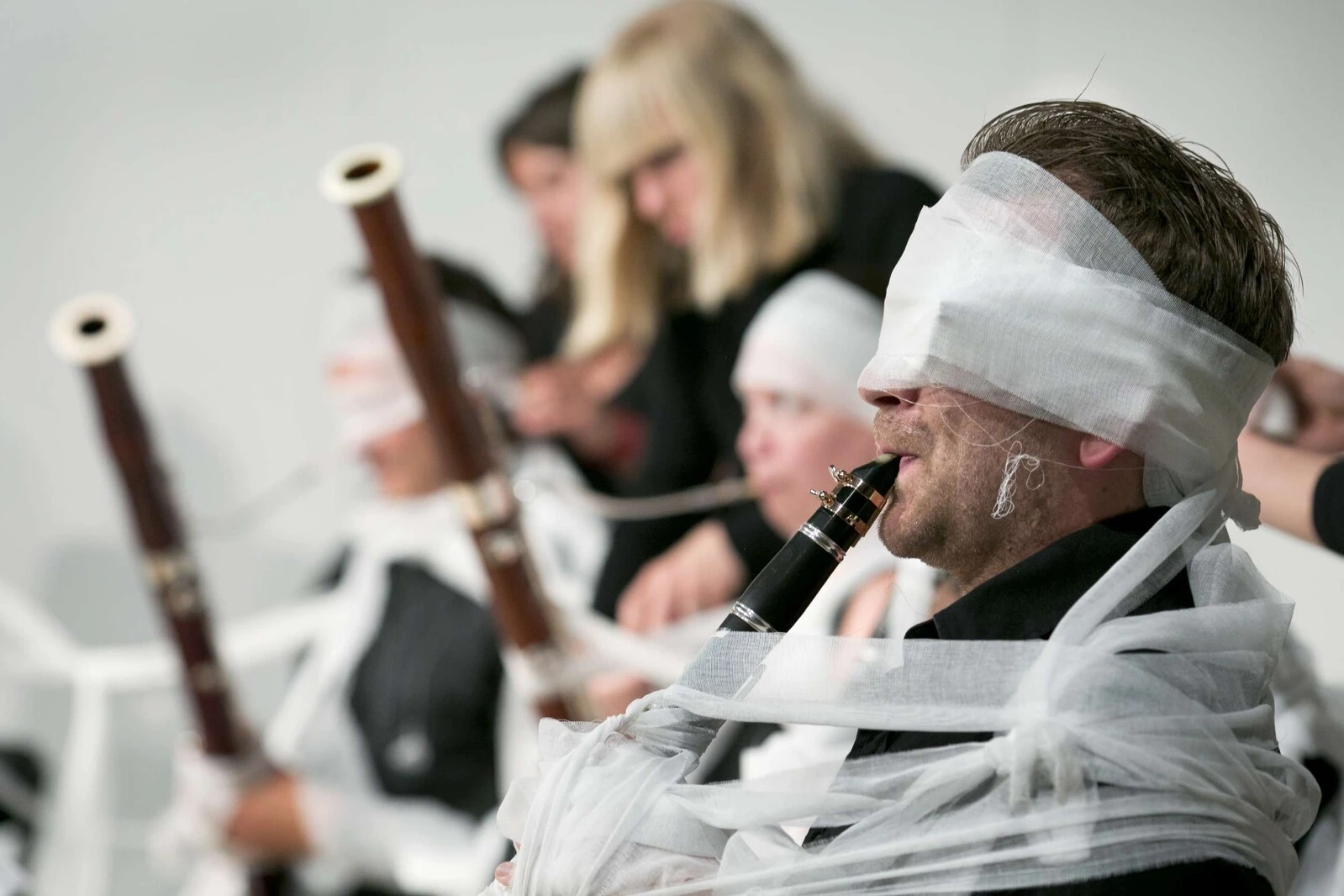
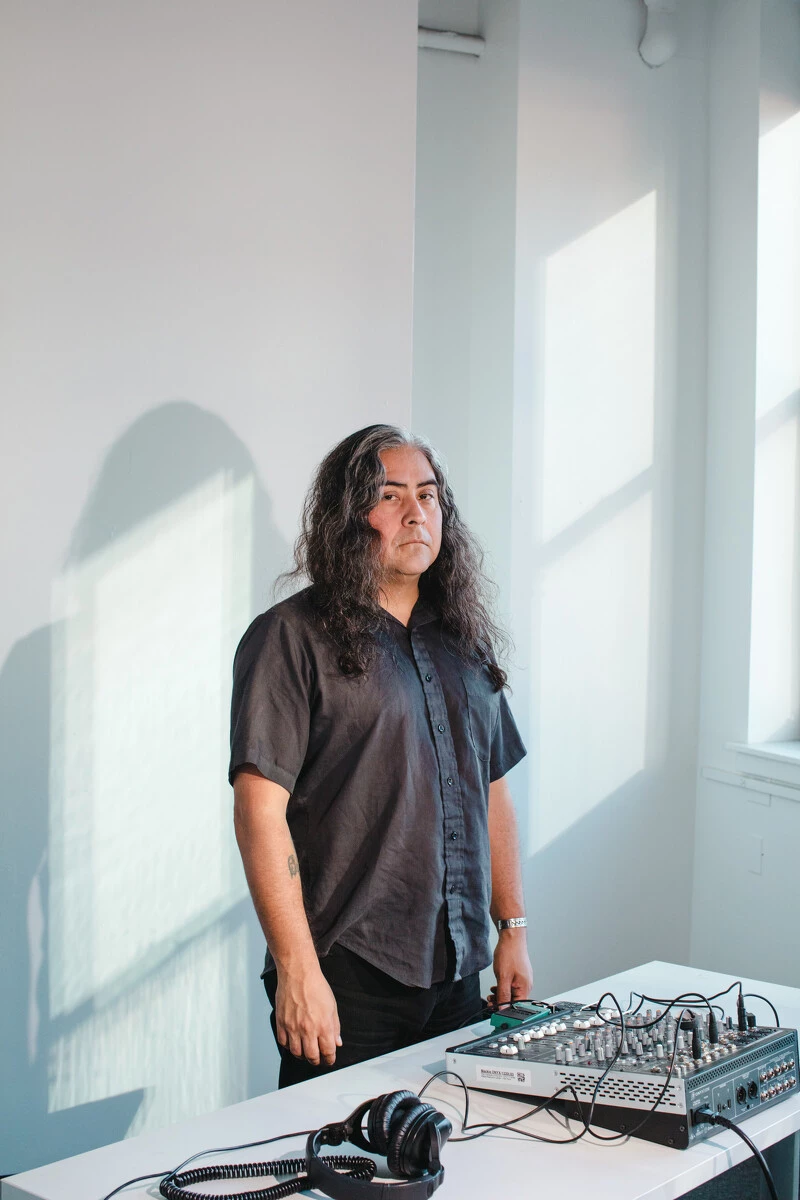
Night for Yoko Ono is the second of two days held in celebration of Yoko Ono’s birthday and the closing of Yoko Ono: Music of the Mind at the MCA. For this evening, Northwestern University’s Contemporary Music Ensemble presents a set of iconic avant-garde compositions, featuring works by Yoko Ono and John Cage led by conductors Alan Pierson (Alarm Will Sound) and Ben Bolter. Joining them onstage is composer and performer Raven Chacon, who engages multiple Yoko Ono Instructions as interludes throughout the evening. The event also includes one of Ono’s seminal works, Sky Piece to Jesus Christ.
Find information and tickets to part one on the Day for Yoko Ono event page.
Program Notes
Director's Note
Yoko Ono’s 1965 Sky Piece for Jesus Christ—in which musicians, playing whatever music they choose, are wrapped in gauze bandages until they can no longer play—was the seed of tonight’s program. The “Jesus Christ” of the title actually refers to the most famous composer who shared Christ’s initials: John Cage, Yoko Ono’s one-time teacher and long-time friend and colleague. It is an epitaph that the two artists used—not always flatteringly!—to refer to one another. They had met six years earlier, and in the intervening time had become central, intertwined figures in New York’s musical avant-garde, where they had developed ideas that reshaped musical thought both in popular and art music spheres. Sky Piece’s themes of freedom (the sky) vs. constriction (the gauze) are ones that they debated through their long relationship, and that run through this concert program that juxtaposes their work.
Ono first met Cage in the late 1950s, as an auditor in his “Experimental Composition” class at the New School in New York. Her then husband, Toshi Ichiyanagi, was one of Cage’s students. The newfound artistic freedoms that Cage explored in his class excited Ono, and Cage’s foundation in Zen thought connected them as well. Soon, Ono was organizing her own performances of experimental music: the Chambers Street Loft Series, where the Fluxus art movement took shape. Cage was a frequent guest. It was here that Yoko developed her own early Zen-inspired works (many later collected in her book Grapefruit), including the ones that fellow composer Raven Chacon performs tonight, and the Pieces for Orchestra. These works are meant to make art something for anyone to participate in: “Art is not a special thing. Anyone can do it,” Ono has said. Some of these are more like Zen thought-experiments than performable pieces: “Step in all the puddles in the city,” instructs one. They involve minimal direction, calling on the performers’ creativity, imagination, and expression to realize the work. Each movement of the Pieces for Orchestra, for instance, gives the performers only a single-word instruction. The interpretations you see tonight were created by the ensemble.
Cage’s work had also opened up new possibilities for what music could be. His iconic 1952 “silent” piece, 4’33”, invited listeners to consider even the unintended sounds of the environment as material for musical experience. But in contrast to Ono, Cage’s artistic and personal ethos was one of restraint: “Permission granted, but not to do whatever you want,” Cage wrote. His Buddhism was distrustful of ego, taste, and any inclination for an artist to impose his own emotions on his listeners. These, he thought, led to predictable art and to a broken culture. He pursued a Zen-inspired disinterestedness: creating processes (often involving chance procedures) to insulate his art from his own personal tastes, resulting in sounds that were unexpected, and that were given space to “be themselves” rather than “vehicles for…expression of human sentiments.”
Cage’s 1950 String Quartet in Four Parts was the beginning of this. Cage constrained his expression in the quartet by making many choices even before beginning composition: choosing a series of numbers to generate all of the time structures of the piece, and a narrow palette of sounds—no more than 15 for each instrument—as the entirety of its musical material. As the movements progress through the seasons—from the lighthearted “Summer” into the stillness of “Winter”—the sounds become increasingly isolated: less in dialogue, increasingly allowed to be themselves. You can hear the direction of Cage’s future work through the progression of these movements.
Cage’s ethos of emotional restraint led to tension with Ono. He critiqued her loft concerts as “too much like a personality show.” And he did not support her choice to separate from Ichiyanagi. After visiting Ono in a hospital during a depressive episode, Cage concluded that she was crucifying herself on the cross of her emotions: “Jesus Christ,” he called her. For her part, Yoko found Cage’s rejection of emotion and expression uncomfortably resonant with the restrictive Japanese culture she’d struggled to escape. “I was not a traditional Japanese woman, and this disappointed them,” Yoko said of Cage and Ichiyanagi. “It has to do with submissiveness, which I certainly didn’t have.”
Ono found the focus on discipline and structure in Cage’s music restrictive too. She didn’t understand why Cage needed to control the duration of 4’33”. “Why did it have to be four minutes and 33 seconds?” she asked. (Cage took this critique in stride, creating 0’00” in 1962 as a response. 0’00” had no specified duration, and embraced Ono’s ethos of music that could be made by anyone.) Cage, she thought, was too wedded to his own ideas. “Mental richness should be worried just as physical richness,” she wrote “Didn’t Christ say that it was like a camel trying to pass through a needle hole, for John Cage to go to heaven?”
And so the homage to Cage in Sky Piece is a complicated one. Is Cage the visionary who opens up to artists the freedom of the sky? Or is he the gauze, straightjacketing musicians until they can no longer make their art?
After the premiere of Sky Piece at Carnegie Hall in 1965, Yoko’s and Cage’s lives took them in different directions, though they continued to spread the ideas they’d developed during those New York years. In 1966, on an errand to retrieve a Beatles manuscript as a gift for Cage, Ono met Paul McCartney. And through McCartney, she met John Lennon weeks later. Their path together is legendary. With The Beatles, Ono brought her avant-garde sensibility across to popular music, shaping radical and shocking work like “Revolution 9”: the sound collage track that ends The Beatles’ 1968 White Album. Cage, who remained more squarely in the art-music avant-garde even as his influence in pop culture grew, came to feel Yoko had been lost to fame. He began work on his own 1970 magnum opus, Song Books: a set of 90 solos for voice, embracing all the different kinds of musical and theatrical work that he had been creating. Singers could select from any of these in any order to craft an individual performance, with instrumentalists joining in with parts from the Cage Concert for Piano and Orchestra. (Ten solos from Song Books are being performed tonight: nos. 6, 15, 18, 32, 35, 43, 64, 82, 89, and 91.) The theme of the work is “We connect Satie to Thoreau.”
Despite all of the freedoms that they have opened up for us, both artists have also had a sense of boundaries that must be fiercely protected. Cage long lamented how musicians used the freedom he gave them: “I must find a way to let people be free without their becoming foolish,” he wrote. “My problems have become social rather than musical.” When composer Julius Eastman performed a realization of a solo from Song Books that involved stripping a man naked on stage as part of a lecture about sex, Cage was outraged: “You can’t do what you want,” he ranted, punctuating the pronouncement by banging his fist on a piano. And days before tonight’s concert, we learned from the Yoko Ono studio that while the Sky Piece offers no instruction on what music can or can’t be performed, there is one unwritten limitation: it can not be performed to the music of John Cage.
Ono and Cage remained friends through the end of Cage’s life. After Ono’s third husband, John Lennon, was killed in 1980, Cage and his partner Merce Cunninghman sent a message: “Dear Yoko, if there’s anything we can do for you, let us know. We send our love.” “Thank you for thinking of us and taking your time in sending a part of you in the past trying year,” Ono responded. “Your words came to us sometimes like a soft breeze, sometimes like a strong wind, all helping both of us to grow happier and wiser.” Ono and Cage reunited publicly in 1987 for Cage’s 75th birthday. The performance marked Ono’s return to the New York avant-garde art scene, which would be ratified with her 1989 solo exhibition at the Whitney Museum of American Art.
These two artists have utterly transformed the landscape in which we create art today: the sense of the breadth of possibilities, the theatricalization of music-making, the so-permeable boundaries between avant-garde and popular spheres. . . . All of this goes back to Yoko and John. The questions they’ve raised about the edges and purposes of artistic freedom, and about the limits of what art can be, are ones we still wrestle with. The great gift that they have left us with is a vastly expanded sense of what a musician can do, and of what it means to be one. The students performing today all grew up in this wide-open art world that Yoko and John created. Where will they take us next?
—Alan Pierson, Director
Billing
HENRY AND LEIGH BIENEN SCHOOL OF MUSIC
| Mind Music | |
|---|---|
| Alan Pierson | Creator and director |
| Alan Pierson and Ben Bolter | Directors |
| Featuring Raven Chacon | |
CONTEMPORARY MUSIC ENSEMBLE
| Alan Pierson and Ben Bolter | Co-directors |
| Shihan Jin | Graduate assistant conductor |
| Matthew Johnson | Production manager |
| Jack Hamill | Technology coordinator |
| Andy Hankes † • ∞ | Flute |
| Kate Tolchinsky † • | Oboe |
| Sophia Ross † • ∞< Nicholas Chesemore † • ∞ |
Clarinet |
| Hudson O’Reilly ∞ | Saxophone |
| Adrian Wittmer † • ∞ | Bassoon |
| Weverton Santos † • | Horn |
| Jalen Dobson † • ∞ | Trumpet |
| Neil Advant † • ∞ | Trombone |
| Amina Knapp φ • ∞ Lucy Nemeth φ • ∞ |
Violin |
| Jacob Westerbeke φ • ∞ | Viola |
| James La Fayette φ • ∞ | Cello |
| Jamie Park • ∞ | Double bass |
| Amy Bao † • | Piano |
| Angela Cabrera † • Jacob Scheidt † • § |
Percussion |
| Ben Bolter • Isabel Yang § Maddy Zuckerman § |
Voice |
SKY PIECE PERFORMERS
| Hannah B. Higgins | Professor, University of Illinois at Chicago |
| Michael Cunningham Paul Lynn Karner Demetrius Antonio Lewis Catherine Lyu Elias Mendel Filio Zoi Milioti |
Members of the Fluxus Movement Seminar |
KEY:
φ Cage: String Quartet
† Ono: Pieces for Orchestra
• Lennon and McCartney
§ Cage: Song Books
∞ Cage: Concert for Piano and Orchestra
Set List
| Gymnopédies (1888) | Erik Satie |
|---|---|
| Sky Piece to Jesus Christ (1965) | Yoko Ono |
| With guests from the University of Illinois at Chicago
These two works will be performed simultaneously. |
|
| Clock Piece (1965) | Yoko Ono |
| Performed by Raven Chacon | |
| String Quartet in Four Parts | John Cage |
| I. Quietly Flowing Along—Summer | |
| 0’00” | |
| Pieces for Orchestra (1962) | Yoko Ono |
| Led by Ben Bolter
No. 1 Peel |
|
| Wood Piece (1963) | Yoko Ono |
| Performed by Raven Chacon | |
| String Quartet in Four Parts | John Cage |
| II. Slowly Rocking—Autumn | |
| 0’00” | |
| Revolution 9 | John Lennon and Paul McCartney |
| arr. Matt Marks | |
| Shadow Piece (1963) | Yoko Ono |
| Performed by Raven Chacon | |
| String Quartet in Four Parts | John Cage |
| III. Nearly Stationary—Winter | |
| Songbooks (1970) | John Cage |
| (includes Concert for Piano and Orchestra (1957–58))
Isabel Yang, Maddy Zuckerman, and Jacob Scheidt, voices |
|
| String Quartet in Four Parts | John Cage |
| IV. Quodlibet—Spring | |
| Lighting Piece (1955) | Yoko Ono |
| Performed by Raven Chacon |
Essay by Carter Miller
The end of the second world war found both John Cage and Yoko Ono in the midst of rather turbulent seasons in their lives. Cage had moved to New York City only a few years earlier with his wife, sculptor Xenia Kashevaroff, and was still in the process of establishing himself in the experimental scene as a composer—or, to quote his former teacher Arnold Schoenberg, an “inventor.” Successful early performances included a percussion concert at the Museum of Modern Art in 1943 featuring his wife, and a joint recital with choreographer Merce Cunningham at the Studio Theater in 1944. The following year, Cage left Kashevaroff for Cunningham, initiating a partnership that would last until the composer’s death in 1992.
More than 6500 miles away, Yoko Ono spent most of 1945 attending grade school in Tokyo. As a child in a well-to-do family, Ono enjoyed access to a prestigious education complete with music lessons from an early age. Nonetheless, after her father was incarcerated at a POW camp in present-day Vietnam during the war, like many Japanese the Ono family (consisting of Yoko’s two younger siblings and their mother) was forced to limit food intake and seek shelter from American air raids, including one in March which killed an estimated 100,000 civilians in the capital. After the war, Ono became the first woman to enter the philosophy department at Gakushūin University and, soon after, the first woman to drop out; in 1952, she transferred to Sarah Lawrence College to be nearer to her family who had previously relocated to the States.
By the time Ono arrived in New York, Cage had already written the famous Sonatas and Interludes collection for prepared piano, the String Quartet in Four Parts, and Music of Changes, an early indeterminate piece conceived for pianist David Tudor. In a letter to Pierre Boulez, Cage described the String Quartet (whose movements are threaded through this program) as containing “no counterpoint and no harmony. Only a line in rhythmic space.” This single musical line unfolds as a precise collection of sonorities, collectively called the “gamut,” are played and recycled within a rigid time structure. Experimenting with the linearity of these limited musical materials allowed Cage, in the words of James Pritchett, to “produce a succession of harmonies that is truly freed from structural responsibility” as well as challenge listeners to interrogate which sounds they hear as “harmonies” in the first place.
Over the course of the String Quartet, the sounds of the gamut gradually detach from one another in a manner that reflects Cage’s increasing incorporation of indeterminacy and sonic independence. Indeed, this fascination with how sounds could exist abstractly and without prescribed functions was also famously shared by composer Henry Cowell, who described the String Quartet in Four Parts in relation to Cage’s ongoing efforts to “get rid of the glue so that the sounds [can] be themselves.” Cowell also taught at the New School for Social Research and encouraged his friend to lecture at the same institution. It was in such a course that Cage taught Toshi Ichiyanagi, an avant-garde composer who was also the first husband of Yoko Ono. Ichiyanagi facilitated Cage’s and Ono’s introduction in the late 50s, and it wasn’t long before the pair were correspondents and collaborators.
Beginning in late 1960, Ono and La Monte Young presented the Chambers Street Loft Series at which many of Ono’s early instruction-based works were performed. These events were routinely attended by figures including Cage, Marcel Duchamp, and George Maciunas, the founder of Fluxus. Several of the scores presented at this concert series were published in Ono’s Grapefruit (1964), an artist’s book containing event scores including, for example, City Piece which instructs performers to “walk all over the city with an empty baby carriage” and Shadow Piece which requires performers to “put your shadows together until they become one.” An early articulation of the conceptual art movement, Grapefruit also contains Ono’s Pieces for Orchestra which were written in 1962 and premiered in 1965. The instructions of the six movements consist solely of single actions, entrusting the interpretation of the work to the performers who effectively co-compose the piece in real time.
Also in 1962, Cage and Ono toured Japan where they gave performances of their work and continued to develop their artistic relationship. Cage wrote 0’00” (subtitled 4’33” no. 2) and dedicated to Ichiyanagi and Ono that year in response to her challenging Cage on why 4’33” had to last for a specified period of time. Ono later wrote that “[Cage] talked about how in the West you had to have a frame, so he dedicated [0’00”] to me.” Whereas 4’33” highlights the unpredictable ambient sounds of a concert venue during a span of exactly 273 seconds, 0’00” lasts for an indeterminate duration and prioritizes the agency and creative freedom of performers. The score itself consists simply of a directive to “perform a disciplined action.”
The late 1960s saw an increase in communication between Ono and Cage, who was working on a book surveying a range of musical notations that would support the nonprofit Foundation for Contemporary Performance Arts. After having met John Lennon at a gallery show in London in 1966, Ono was integral to securing the lyric manuscript of “The Word,” released on The Beatles’ album Rubber Soul (1965) which was included in Cage’s Notations (1973). Considering the book is primarily populated with twentieth century concert repertoire, the inclusion of the Beatles manuscript highlighted the growing influences of countercultural popular music on experimentalism (and vice versa).
For example, on their 1968 White Album, the Beatles included “Revolution 9,” an eight-minute sound collage incorporating the musique concrète techniques of Boulez and Stockhausen (who, in fact, appears in the crowd depicted on the album cover of Sgt. Pepper’s Lonely Hearts Club Band). Treating the recorded material from the song “Revolution 1” with electronic manipulation, including vocal overdubs, tape loops, echo and distortion effects, and 8-track stereo panning, the work also samples previously unreleased Beatles recordings. While originally credited to Lennon-McCartney, “Revolution 9” was primarily created by Lennon, Ono, and George Harrison and was arranged for orchestra by Matt Marks, a founding member (alongside this evening’s conductor Alan Pierson) of the new music ensemble Alarm Will Sound. Marks’s acoustic translation of the electronic sound collage was described by The New York Times as “eerily accurate” and was released as the first track on the group’s 2016 album Modernists.
For the culmination of this concert, Cage’s Song Books will be performed alongside Yoko Ono’s Sky Piece to Jesus Christ (1965). Song Books contains four types of pieces: songs; songs with electronics; theatrical directions; and theatrical directions with electronics. The work consists of ninety distinct solos, such as Aria 15 which instructs performers to type a text meaning that the “artist does not have the right to waste the listener’s time unnecessarily” or Aria 64 which instructs performers to shout “Nichinichi kore kōnichi!” (a Zen Buddhist proverb roughly translating to “try to spend every day meaningfully”) in a manner “like a football cheer-leader.” Song Books also invites instrumentalists to join and, in this case, play Cage’s Concert for Piano and Orchestra (1958).
Written just a few years prior to the release of Ono’s Grapefruit, the Concert was so named because every part—not just that of the piano—is a solo. The work lacks a full score, consisting rather of thirteen instrumental parts, a conductor part, and a piano part. This part, which was also independently published as Solo for Piano, incorporates 84 distinct types of notations over 63 pages and was itself displayed in galleries as a visual artwork. In each part, Cage employed chance procedures to compose “specific directives and specific freedoms” such as instructing the conductor to move their arms in the manner of a giant irregular stopwatch or allowing performers to choose the duration and amplitude of a given pitch based on the size of its appearance on the page.
The Concert for Piano and Orchestra was premiered, with David Tudor as pianist and Merce Cunningham as conductor, at a retrospective concert on the 15 May 1958 organized by Tudor to honor the first 25 years of Cage’s career. Martin Iddon and Philip Thomas note several similarities between the work’s premiere in New York and that of Stravinsky’s The Rite of Spring in Paris in 1913, including an audibly disgruntled audience, though several authors note that a wide range of artists attended the retrospective to support and honor Cage and his work.
Concurrently, in Sky Piece to Jesus Christ Ono explores what she describes as “the epitome of freedom in contrast to the inner and outer bonds visualized during the performance,” referring to the performers’ task of wrapping playing members of an orchestra in medical gauze until they can no longer play. The titular Jesus Christ actually refers to John Cage (Christ and Cage shared the initials J. C.) and reflects Ono’s view of Cage as a sort of artistic liberator and/or proselytizer. This title can be read simultaneously as an indication of respect and as a critique of the hegemonic power exercised by the western patriarchs of postwar experimentalism.
Ono and Cage remained in contact even after their collaborations of the late 50s and 60s. After marrying John Lennon in 1969, Ono collaborated with her new husband on the album Unfinished Music No. 2: Life With The Lions which includes the track “Two Minutes Silence,” consisting of exactly that. During the 1970s (and amidst efforts by Nixon to have Lennon deported), the couple also financially supported Cage and the Foundation for Contemporary Performance Arts. Following Lennon’s assassination in 1980, Ono continued to keep Cage updated about her and her son Sean’s life, invited him to events, and maintained her support of his projects. She has continued to create and perform well into her old age; the current exhibition Yoko Ono: Music of the Mind at the Museum of Contemporary Art in Chicago is scheduled to close on 22 February 2026, four days after what will be Ono’s 93rd birthday.
—Carter Miller, PhD Candidate, Musicology, Northwestern University
About the Artists
Northwestern University’s Contemporary Music Ensemble (CME) presents exciting concerts of wide-ranging contemporary works. A one-on-a-part ensemble of approximately 20 players, CME trains students to take on this challenging repertoire while thriving in a large chamber ensemble setting. Each year, CME plays side-by-side with great guest artists, and collaborates with student and faculty composers from the Northwestern community as well as major visiting guests.
Associate Director of the Institute for New Music and Co-Director of Contemporary Music Ensemble Ben Bolter made his orchestral conducting debut with the National Symphony Orchestra at age 25, with the Washington Post praising his performance: “Bolter spotlighted the showiest aspects . . . and made it look easy.” As part of Chicago’s acclaimed Ear Taxi Festival, his world premiere of Drew Baker’s NOX was named Chicago’s Best Classical Music Performance of 2016 by the Third Coast Review. John von Rhein of the Chicago Tribune remarked: “[Drew Baker’s] NOX made an altogether striking close to an absorbing, eclectic program, quite the best of the Ear Taxi events.” Bolter has also served as an assistant conductor with the Indianapolis Symphony and has been a frequent guest at the Civic Orchestra of Chicago.
Bolter has worked with some of the country’s leading new music ensembles. He led the inaugural performance of the acclaimed Grossman Ensemble in what the Chicago Tribune described as a “historic” debut and a performance that “set a high standard for itself—and lofty expectations for the concerts ahead.” He has also worked extensively with the International Contemporary Ensemble, Fulcrum Point New Music Project, Third Coast Percussion, Spektral Quartet, Indiana University New Music Ensemble, Square Peg Round Hall, and soloists, including Claire Chase, Tony Arnold, Kate Soper, Vijay Iyer, and Iarla Ó’Lionáird, among others. Bolter has given world premieres by Shulamit Ran, Sam Pluta, Marcos Balter, Tonia Ko, Anthony Cheung, and Matthew Peterson, and has worked closely with major figures such as Steve Reich, Tania León, Julia Wolfe, John Luther Adams, David Lang, and Esa-Pekka Salonen.
Under his stage name “Boltah,” he has released original albums on streaming platforms and performed at venues nationwide. Boltah has written music for dance companies, animations, and exhibitions. He recently collaborated with artists/writers Monica Rickert-Bolter and Joel Rickert on an animatic, which was featured at the grand opening of the National Public Housing Museum in April 2025. The project was also awarded a Department of Cultural Affairs and Special Events (DCASE) grant to create a published and digital comic book.
Raven Chacon is a composer, performer, and installation artist born at Fort Defiance, Navajo Nation. A recording artist over the span of 24 years, Chacon has appeared on over 80 releases on national and international labels. He has exhibited, performed, or had works performed at LACMA, The Whitney Biennial, Borealis Festival, SITE Santa Fe, Swiss Institute Contemporary Art New York, and more. As an educator, Chacon is the senior composer mentor for the Native American Composer Apprentice Project (NACAP). In 2022, he was awarded the Pulitzer Prize in Music for his composition Voiceless Mass, and in 2023 was awarded the MacArthur Fellowship.
Grammy-winning Alan Pierson has been praised as “a dynamic conductor and musical visionary” by The New York Times, a “conductor of monstrous skill” by Newsday, “gifted and electrifying” by the Boston Globe, and “one of the most exciting figures in new music today” by Fanfare. He is the Artistic Director and conductor of the acclaimed ensemble Alarm Will Sound, which has been called “the future of classical music” by The New York Times and “a sensational force” with “powerful ideas about how to renovate the concert experience” by The New Yorker. Pierson served as the Artistic Director and conductor of the Brooklyn Philharmonic. The New York Times called Pierson’s leadership at the Philharmonic “truly inspiring,” and the New Yorker’s Alex Ross described it as “remarkably innovative, perhaps even revolutionary.”
As a guest conductor, Pierson has appeared with the Los Angeles Philharmonic, the Chicago Symphony Orchestra, the Hamburg Symphony Orchestra, L.A. Opera, Nationaltheater Mannheim, the London Sinfonietta, the Steve Reich Ensemble, the Orchestra of St. Luke’s, the New World Symphony, and the Silk Road Project, among other ensembles. He is co-director of the Northwestern University Contemporary Music Ensemble, and has been a visiting faculty conductor at the Indiana University Jacobs School of Music, the Eastman School of Music, and at the Banff Centre for the Arts andCreativity.
Pierson regularly collaborates with major composers and performers, including Yo Yo Ma, Steve Reich, Dawn Upshaw, Osvaldo Golijov, John Adams, David T. Little, Augusta Read Thomas, David Lang, Donnacha Dennehy, La Monte Young, Tyshawn Sorey, and choreographers John Heginbotham, Christopher Wheeldon, Akram Khan and Elliot Feld. He has spearheaded critically acclaimed cross-genre collaborations with artists like Yasiin Bey, Erykah Badu, and Medeski Martin and Wood.
Pierson is passionate about creating theatricalized performance experiences that use music, theater, and multimedia to connect listeners more deeply to great music. Beyond his work in the concert hall, Pierson is an avid recording producer and artist, having released 30 albums on Nonesuch Records, Sony Classical, Cantaloupe Music, Oehms Classics, and Sweetspot DVD. Pierson received bachelor degrees in physics and music from the Massachusetts Institute of Technology, and a doctorate in conducting from the Eastman School of Music. In 2022, he received the Eastman School of Music Centennial Award.
Acknowledgements
Special thanks to Ryan Dohoney and Rob Haskins for sharing their scholarly insights into John Cage and Yoko Ono, to Joachim Schamberger, Gavin Chuck, and Paul Melnikow for their directorial wisdom, and to Manual Cinema, Jonathan McQuade, Jude Stewart, Seth Brodsky, and Lev Stewart-Brodsky for all of their help with equipment for tonight’s performance.
Related Exhibition
October 18, 2025 - February 22, 2026
Yoko Ono: Music of the Mind
Funding
Performance
Performances during Yoko Ono: Music of the Mind are generously supported by the Zell Family Foundation. This program is partially supported by a grant from the Illinois Arts Council.
Lead support for the 2025–26 season of MCA Performance is provided by Elizabeth A. Liebman.
Generous support is provided by Anne L. Kaplan; and Carol Prins and John Hart/The Jessica Fund.
The MCA is a proud member of the Museums in the Park and receives major support from the Chicago Park District.
Exhibition
Lead support for Yoko Ono: Music of the Mind is provided by the Harris Family Foundation in memory of Bette and Neison Harris, the Zell Family Foundation, Cari and Michael Sacks, Karyn and Bill Silverstein, and R. H. Defares.
Major support is provided by Bank of America; Barbara Bluhm-Kaul and Don Kaul; Christie’s; Nancy and Steven Crown; Laura and Tony Davis and Linden Capital Partners; Susie L. Karkomi and Marvin Leavitt, Karkomi Family Fund; Liz and Eric Lefkofsky; Lugano; H. Gael Neeson, Edlis Neeson Foundation; D. Elizabeth Price; Carol Prins and John Hart/The Jessica Fund; Robin Loewenberg Tebbe and Mark Tebbe; Lynn and Allen Turner; Charlotte R. Cramer Wagner and Herbert S. Wagner III of Wagner Foundation; and the Walter and Karla Goldschmidt Foundation.
Generous support is provided by The Francis L. Lederer Foundation.
This exhibition is supported by the MCA’s Women Artists Initiative, a philanthropic commitment to further equity across gender lines and promote the work and ideas of women artists.