Six Scores for Yoko Ono
November 04, 20256:00 pm - 7:30 pm
Free with museum admission



About the Event
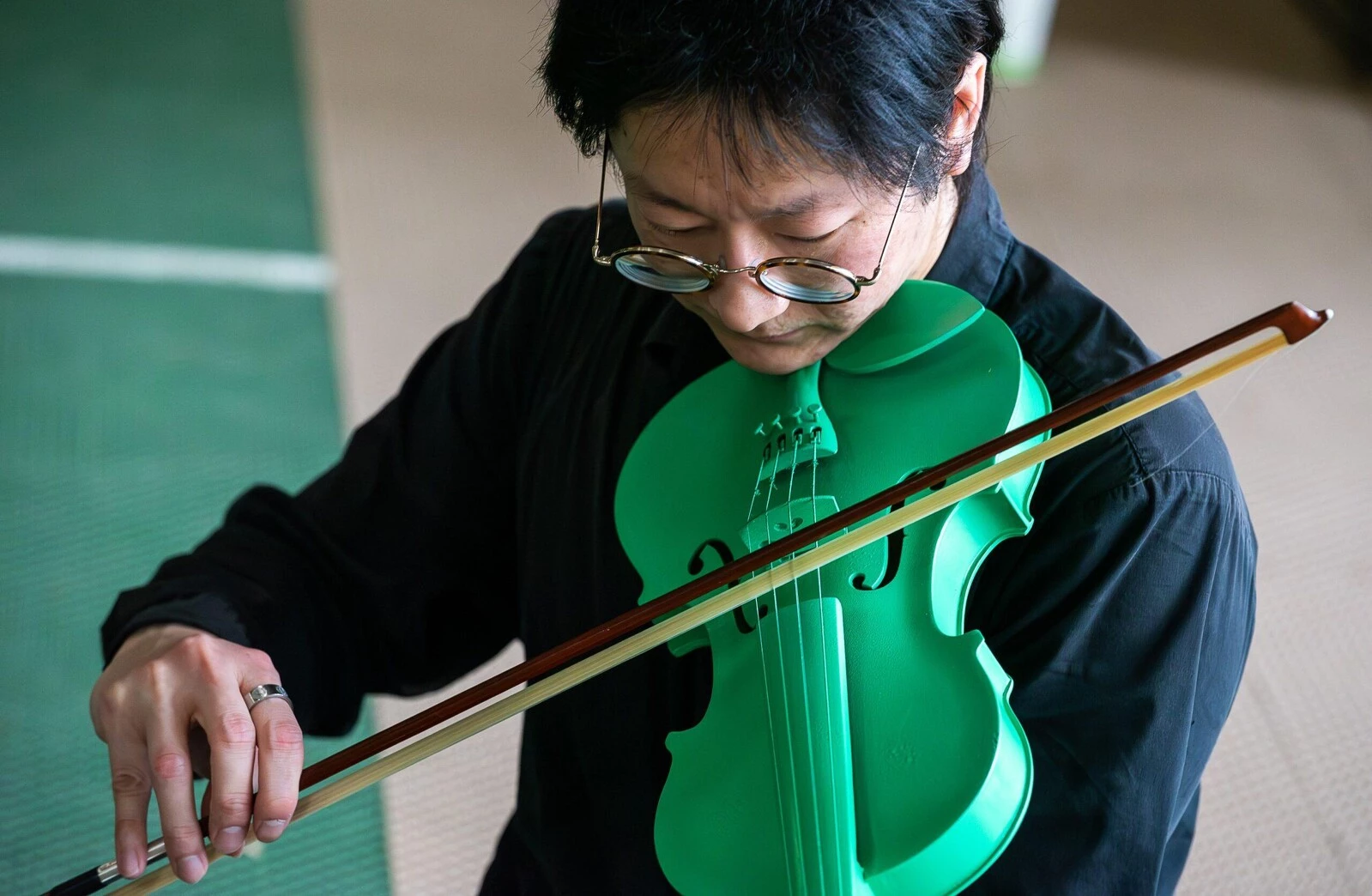
Experience the musical context of Yoko Ono’s early work with performances of five scores from the 1960s—by Mieko Shiomi, Nam June Paik, Yoko Ono, and George Maciunas—and a new commission by Curatorial Fellow Andrew Hansung Park. The performances track the destruction of a violin, smashing boundaries between everyday sound and music.
This performance program is organized by Curatorial Fellow Andrew Hansung Park with Daniel Atkinson as part of the MCA DNA Research Initiative, which supports interdisciplinary research projects related to the MCA Collection.
Access Information
English CART captioning is available for this event. To request additional accessibility services, please contact us at [email protected] or 312-397-4076.
About the Artists
Lidia Ferrara
Lidia Ferrara is a PhD candidate in the Department of Art History at the University of California, Los Angeles (UCLA). Her research, writing, and teaching span the fields of modern and contemporary art history, museum studies, and performance studies. Lidia’s research areas include global histories of performance art and its institutional circulation, critical legacies of postmodern discourse, and the intersections between contemporary art history and contemporary art conservation.
Ferrara’s dissertation is titled “Staging Strategies: Theatricality, Remaking, and the Afterlife of 1960s and 1970s Feminist Performance Art.” Her study traces how three American women artists returned to their historical performance works and appealed to theatrical techniques to remake them for museum display in the 1990s and early 2000s. Ferrara is also a Research Assistant at the Getty Research Institute in Los Angeles. She was formerly Curatorial Assistant, Collections, at the Guggenheim Museum in New York. Ferrara holds an MA in Art History from UCLA and a BA in Art History and French from Barnard College.
Gordon Fung
Gordon Fung (b. 1988, San Francisco, CA; lives in Chicago, IL) is a transdisciplinary artist-curator, writer, performer, multi-instrumentalist, and runaway composer who works across a wide range of time-based media, including audiovisual performances, new media installations, experimental film/video, media archaeology, participatory works, performance arts, and Happenings, among others. Inspired by the unique Chicago video/media arts lineage and collectivity in Fluxus, Fung has founded and directs the neo-Fluxus theater troupe //sense to showcase large-scale experimental participatory theater, exhibitions, and screenings. By establishing a democratized and decentralized space, he initiates efficacious social changes through arts, media, technology, games, and life. As a firm believer in collectivism and synergy, his curations cultivate two maxims: “making good communities better” and “finding arts in all things.”
As a community builder and experimental theater-maker, he emphasizes intercultural, interdisciplinary, and intergenerational conversations and collaborations to pursue peace-making, oneness, and interconnectedness in humanity. With extensive use of readymade objects and readily available media tools, his theaters fabricate an organic playground and brave space for participants to reimagine artmaking through deskilling and unlearning. He has presented experimental theaters at Black Mountain College Museum + Arts Center (2025), Peoria Civic Center (2025), the historic Black Mountain College (2025), the International Museum of Surgical Science (2024), Glenwood Avenue Arts Festival (2024), No Nation Art Lab (2023), Comfort Station (2023), and MacLean Ballroom (2023).
As an award-winning but runaway composer, his compositions have been performed in Canada, China, Croatia, Denmark, Germany, Hong Kong, Indonesia, Italy, the Netherlands, Poland, Russia, Singapore, South Korea, Spain, Taiwan, and the United States.
Kaoru Kuribayashi
Kaoru Kuribayashi is an interdisciplinary artist whose work engages with traditional forms as living, evolving practices. She holds master’s degrees from Goldsmiths, University of London (2020), and UCLA (2024), where she researched how Japanese traditional culture articulates mindfulness, ritual, and transcendental experience in a global contemporary context.
Her practice spans tea, fabric, performance, and meditative installation, and is rooted in her training in Chanoyu (Japanese tea ceremony), which she began at age ten. She focuses on micro-gestures and sensory precision, exploring how traditional arts can prompt slowness, embodied attention, and cross-cultural resonance. Rather than preserving tradition in a fixed form, she approaches it as a porous system—open to reinterpretation and quiet intervention.
Andrew Hansung Park
Andrew Hansung Park is an art historian, composer, and violinist who researches the intersections between modern/contemporary art and histories of sound across North America and East Asia. He is currently an art history PhD candidate at UCLA as well as a 2025–26 Predoctoral Fellow at the Smithsonian American Art Museum. Park has also been the recipient of fellowships from the Museum of Contemporary Art Chicago/Chanel Culture Fund and the Terasaki Center for Japanese Studies. His dissertation, “’A Different Kind of Jazz’: Sam Gilliam and the Work of Improvisation,” examines the titular artist’s understudied output in assemblage and sculpture from 1968 to 1985 as it flexibly responded to developments in free jazz, the Black Arts Movement, Land Art, and public art.
Park’s own musical practice spans chance, collage, extended techniques, experimental sound, and traditional classical music. He studied composition with Anna Weesner and Ian Krouse, and his music has been performed by the Dedalus Quartet. He was a past apprentice violinist at the National Music Festival, in addition to being a bass drummer for the University of Pennsylvania’s marching band. Hansung Park has also worked in various roles at the Getty Research Institute (where he contributed to the exhibition Sensing the Future: Experiments in Art and Technology), UCLA’s PEER (Practice-based Experimental Epistemology Research) Lab, Glenstone, and the Walters Art Museum. He completed his bachelor’s degree at the University of Pennsylvania as a Benjamin Franklin Scholar in 2018.
Related Exhibition
October 18, 2025 - February 22, 2026
Yoko Ono: Music of the Mind
Related Content
Video Documentation

Exhibition
Lead support for Yoko Ono: Music of the Mind is provided by the Harris Family Foundation in memory of Bette and Neison Harris, the Zell Family Foundation, Cari and Michael Sacks, Karyn and Bill Silverstein, and R. H. Defares.
Major support is provided by Bank of America; Barbara Bluhm-Kaul and Don Kaul; Christie’s; Nancy and Steven Crown; Laura and Tony Davis and Linden Capital Partners; Susie L. Karkomi and Marvin Leavitt, Karkomi Family Fund; Liz and Eric Lefkofsky; Lugano; H. Gael Neeson, Edlis Neeson Foundation; D. Elizabeth Price; Carol Prins and John Hart/The Jessica Fund; Robin Loewenberg Tebbe and Mark Tebbe; Lynn and Allen Turner; Charlotte R. Cramer Wagner and Herbert S. Wagner III of Wagner Foundation; and the Walter and Karla Goldschmidt Foundation.
Generous support is provided by The Francis L. Lederer Foundation.
This exhibition is supported by the MCA’s Women Artists Initiative, a philanthropic commitment to further equity across gender lines and promote the work and ideas of women artists.




Performances during Yoko Ono: Music of the Mind are generously supported by the Zell Family Foundation.